Activist education and expert speakers empowering communities to oppose war and oppression globally

Register for free teach-in “The Iran Crisis and the Path Forward” | June 23 at 8:00pm ET

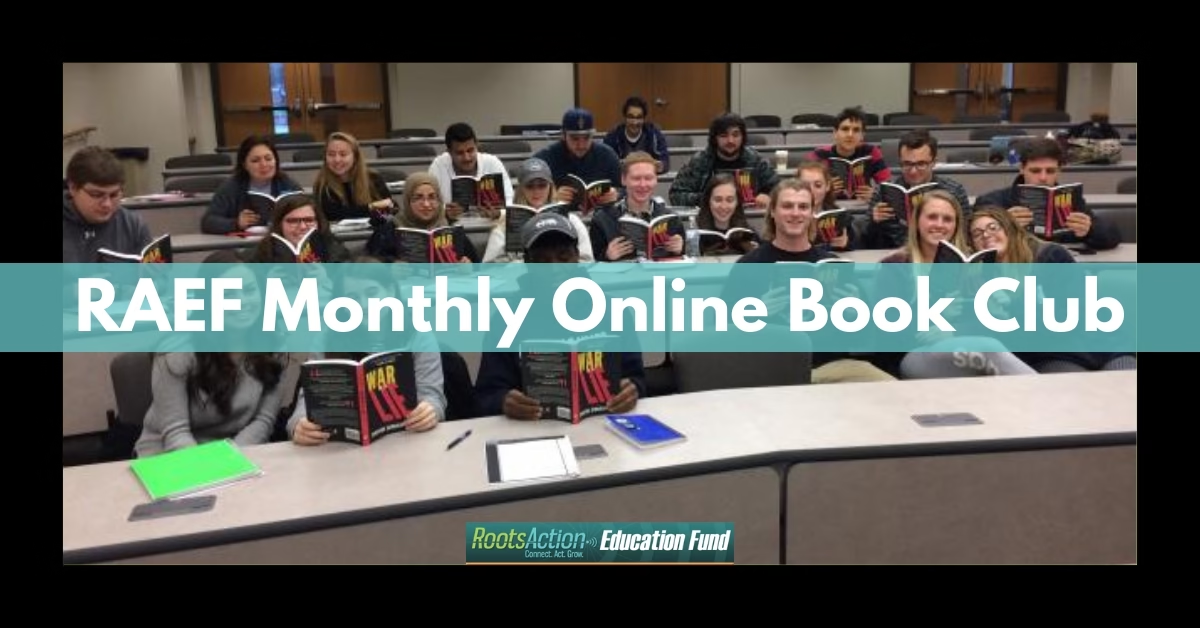
At 5 p.m. PT / 8 p.m. ET on the first Wednesday of every month, you can spend an hour asking your questions of the author of one of the most useful recent books for progressive activism.  We’ll post information about each upcoming book and author here well ahead of time, to give you a chance to acquire and read the book beforehand. This is a free public service open to all.

Upcoming Book Clubs

May 6, 2026

Join us for the May 2026 online book club on May 6 at 5 p.m. PT / 8 p.m. ET with Lily Geismer, author of Left Behind: The Democrats’ Failed Attempt to Solve Inequality. The event is free. Please come and ask questions!

The 40-year history of how Democrats chose political opportunity over addressing inequality—and how the poor have paid the price

For decades, the Republican Party has been known as the party of the rich: arguing for “business-friendly” policies like deregulation and tax cuts. But this incisive political history shows that the current inequality crisis was also enabled by a Democratic Party that catered to the affluent.

The result is one of the great missed opportunities in political history: a moment when we had the chance to change the lives of future generations and were too short-sighted to take it.

Historian Lily Geismer recounts how the Clinton-era Democratic Party sought to curb poverty through economic growth and individual responsibility rather than asking the rich to make any sacrifices. Fueled by an ethos of “doing well by doing good,” microfinance, charter schools, and privately funded housing developments grew trendy. Though politically expedient and sometimes profitable in the short term, these programs fundamentally weakened the safety net for the poor.

This piercingly intelligent book shows how bygone policy decisions have left us with skyrocketing income inequality and poverty in America and widened fractures within the Democratic Party that persist to this day.

Lily Geismer is an associate professor of history at Claremont McKenna College. She researches and teaches about recent political and urban history in the United States with a focus on liberalism and the Democratic Party. She is the author of Left Behind: How the Democrats Failed to Solve Inequality and Don’t Blame Us: Suburban Liberals and the Transformation of the Democratic Party.  Her work has appeared in The New York Times, Washington Post, New Republic, Jacobin, and Dissent and on NPR and other podcasts. A native of Massachusetts, Geismer currently resides in Los Angeles.

Left Behind lucidly conveys how the Clintonian ‘New Democrats’ of the 1990s looked to beat Republicans with market-based policies, but in the end contributed to traumatic losses for all too many and a steep decline in public trust. The struggle underway for the soul of the Democratic Party seems all the more urgent in light of this bracing reassessment.”

Nancy MacLean, author of Democracy in Chains and finalist for the National Book Award


Left Behind is a powerful critique of a technocratic, market-driven approach to government that has never lived up to its promise. Geismer shows in painful detail how the Democratic Party of the recent past could have helped the poor—but chose not to fight for them. This is not just history—it’s a map that takes us, inexorably, to the mess we’re still in.”

Stephanie Kelton, New York Times–bestselling author of The Deficit Myth


“Geismer’s outstanding Left Behind addresses a critical breach in our understanding of how the Democratic Party transformed from ‘big government’ liberalism to the champions of privatization. These policy choices have contributed to inequality and social instability, the impacts of which underlie the social unrest and disquietude that roils US society today. A crucial read.”

Keeanga-Yamahtta Taylor, author of Race for Profit and finalist for the 2020 Pulitzer Prize in History


“Tremendous. This book shows how the ideas of the Clinton-era Democrats emerged historically, setting them up for a clear and convincing debunking. We’re along for the ride with these characters as they become enamored of horrible ideas, with disastrous consequences. This book is an absolute must-read, especially for those who think they already know this story.”

Chenjerai Kumanyika, assistant professor at Rutgers and cohost of the podcast Uncivil


Left Behind should spur serious soul-searching among the American center-left. It is a book about well-intentioned policy not working out, but also about blasé indifference of policymakers as to whether their policies worked or not, and whether the point was for them to ‘work’ for the people affected by policy or for ideas to work in a speech.”

The New Republic


“Geismer’s book is a wonderfully detailed history of a now-extinct faith.”

New York Times Book Review


“Geismer deftly weaves politics with policy to show how the Democrats reimagined poverty as a market failure… Catnip for policy wonks and political junkies, offering solid lessons for Democrats going forward.”

Kirkus


“Framing the story as a tragedy of good intentions gone wrong, Geismer transforms wonky policy matters into an unlikely page-turner. Readers will gain valuable insight into the Clinton presidency and its legacy in today’s distrust between progressives and centrist Democrats.”

Publishers Weekly


“Lily Geismer’s impressive, readable new book on the history of the New Democrats.”

Washington Monthly


“I found this book to be particularly captivating, often shedding light the origin of policy positions espoused by prominent Democratic leaders today.”

The Cascadia Advocate


“Lily Geismer has performed a great service to America…”

OB Rag


“[A] provocative examination of the Bill Clinton presidency, its political and intellectual roots, and its lasting impact.”

Jacobin


“[A] detailed examination.”

The Baffler


“Because it is a true intellectual history in this sense, it is more useful than other accounts, and also more respectful, without tempering its critique, because it takes these politicians and public intellectuals seriously on their own terms.”

Democracy Journal


“This history of ideas is important, and the book does an excellent job of covering the policy transformation within the Democratic Party.”

Choice


“Exciting…Left Behind convincingly shows that Democrats helped shape modern American politics rather than only being overwhelmed by the Right.”

Public Books

Buy the book here, or at your local book store.

June 3, 2026

Join us for the June 2026 online book club on June 3 at 5 p.m. PT / 8 p.m. ET with Les Leopold, author of The Billionaires Have Two Parties, We Need One of Our Own: How Working People Can Build Independent Political Power. The event is free. Please come and ask questions!

The Billionaires Have Two Parties, We Need One of Our Own summarizes recent survey data1 to argue that a majority of voters in four eastern/midwestern industrial states (Michigan, Ohio, Pennsylvania, and Wisconsin) support bold policies intended to curb corporate power, ensure the wealthy pay their fair share of taxes, and improve the job prospects and standards of living for the millions of Americans who depend on their labor, not their investments, to support themselves. It also reports that to achieve these goals a large majority of these same voters are interested in and prepared to join an independent, grass-roots political association, not beholden to either of the major parties. Briefly put, they have had it with politics as usual and are impatient to replace a system biased toward the moneyed classes with one that watches out for the working classes.

Les Leopold is the co-founder and executive director of the Labor Institute. His books include:

Wall Street’s War on Workers: How Mass Layoffs and Greed Are Destroying the Working Class and What to Do About It 

Runaway Inequality: An Activist’s Guide to Economic Justice 

How to Make a Million Dollars an Hour: Why Financial Elites Get Away With Siphoning off America’s Wealth 

The Looting of America: How Wall Street’s Game of Fantasy Finance destroyed our Jobs, Pensions and Prosperity, and What We Can Do About It 

The Man Who Hated Work and Loved Labor: The Life and Times of Tony Mazzocchi

Buy the book at your local book store.

July 1, 2026

Join us for the July 2026 online book club on July 1 at 5 p.m. PT / 8 p.m. ET with Nell Bernstein, author of In Our Future We Are Free: The Dismantling of the Youth Prison. The event is free. Please come and ask questions!

Over the past twenty years, one state after another has shuttered its youth prisons and stopped prosecuting kids as adults, slashing the number of children locked in cages by a stunning 75 percent. How did this remarkable change come about? In the follow-up to her 2014 award-winning book Burning Down the House, journalist Nell Bernstein offers an eye-opening and inspiring look at the forces that converged to move us from a moral panic about “juvenile superpredators” in the 1990s to a time in which the youth prison is rapidly fading from view. 

In Our Future We Are Free begins and ends with the imprisoned youth who took a leading role in their own liberation. Through vivid profiles, Bernstein chronicles the tireless work of young activists, parents, litigators, researchers, and journalists to expose and challenge the racist brutality of youth prisons, as well as the surprising story of prison officials who worked from the inside to close their institutions for good. In a welcome “good news” account of positive change, this gripping story describes how communities are pursuing safety, rehabilitation, and accountability outside of locked institutions, and offers a model for how the United States might overcome its addiction to incarceration. 

A veritable master class in social change, In Our Future We Are Free is essential reading for anyone wanting to understand how large-scale transformation is possible.

Praise for In Our Future We Are Free:
“A triumphant story of how young people, parents and their allies reclaimed a future for themselves and generations to come.”
Van Jones, CNN host and founder of DreamMachine.org

“In this fraught political time when it seems that all organized human rights movements are in constant peril, social justice journalist Nell Bernstein’s account of this panoramic grassroots victory over the brutal policies formerly embedded in the juvenile incarceration system reminds us what can still be possible despite the reactionary leanings of those who hold the reins of power.”
Richard Price, author of Clockers and screenwriter of The Wire

“Nell Bernstein is a national treasure whose passion and research enrich us all.”
Tananarive Due, Los Angeles Times Book Prize winner for The Reformatory

“Award-winning journalist Nell Bernstein chronicles the remarkable, family-led movement that has transformed youth incarceration in America—cutting the number of children in cages by 75 percent. Through powerful storytelling and deep reporting, Bernstein delivers a gripping, hopeful testament to the power of love, resistance, and redemption in an era hungry for change.”
Chesa Boudin, executive director of the Criminal Law & Justice Center at the University of California, Berkeley School of Law

Nell Bernstein is Directing Advocate for Communications at the Youth Law Center, and the author of Burning Down the House, winner of the American Bar Association’s Silver Gavel Award; All Alone in the World, a Newsweek Book of the Week; and In Our Future We Are Free (all published by The New Press). She is a former Soros Justice Media Fellow, a MacDowell Fellow, and a winner of a White House Champion of Change award. Her articles have appeared in The New York TimesThe Washington PostGlamourSalonMother Jones, and other publications. 

Buy the book at your local book store or here.

August 5, 2026

Join us for the August 2026 online book club on August 5 at 5 p.m. PT / 8 p.m. ET with Danielle Chynoweth and Elizabeth Adams, authors of Remaking Democracy: How We Make the Worlds We Want. The event is free. Please come and ask questions!

In Remaking Democracy, seasoned organizers and teachers Chynoweth and Adams introduce readers to the Spiral of Change—a framework for making democratic change in oppressive social systems. Using the Spiral of Change, readers will be equipped to analyze the root causes of the issues we face and design solutions that transform themselves as they transform the world.

How can we empower ourselves and our communities to make lasting social change?

Remaking Democracy is a guidebook for social change. We are at a watershed moment of rising fascism and rising seas: our institutions are failing us, health crises ravage our communities, and the natural world has been thrust into catastrophic climate freefall. Despair threatens to overtake hope in our visions of the future.

In these pages, organizers and teachers Danielle Chynoweth and Elizabeth Adams offer analysis and strategy for sustainable transformation. This accessible and practical resource presents case studies alongside a design toolkit that equips readers to participate in creating the abundant worlds we want. Remaking Democracy empowers us—individually and in groups—to make lasting social change on every level, so that we who are affected by systems can become their creators.

“Now is the time to put forward bold, people-centered solutions. To do so, we need to learn from past movements, not rehash them. We need organizers who have been on the frontlines training a new crop of leaders that can see beyond their own time. Remaking Democracy: How We Make the Worlds We Want is a training manual for our future.” 
—Carol Ammons, Illinois State Representative, Co-chair of Illinois Black Caucus

“For the first time in human history, a connected, just, and equitable global society is possible. What we lack is mass participation in imaging and creating that world. Remaking Democracy: How We Make the Worlds We Want helps us think beyond the reality of our current existence to forge a radically inclusive, global community.” 
—Alfredo Lopez, Founder of the May First Movement Technology, a founder of the Radical Elders Organization, and one of the organizers of the U.S. Social Forum.

“We need to know how to do the work of social change, and how to build structures to sustain our values of care, justice, and respect for the earth and all its inhabitants. The guidebook for this change is Remaking Democracy.”
—Safiya U. Noble, Author of Algorithms of Oppression, David O. Sears Presidential Endowed Chair of Social Sciences and Professor, UCLA Director of the Center on Resilience & Digital Justice and UCLA DataX-Data Justice Initiative

“Danielle Chynoweth has been generously sharing her passion, strategies, and methods of activism with us in the Global South. This book comes at the perfect time, when people everywhere are anxious about the new world order and citizen activism matters more than ever.” 
—Keiko Sei, media activist, Myanmar and Thailand

“School for Designing a Society (SDaS) has offered a rare intellectual and creative nest—one that has helped me navigate the space between collectivist Eastern traditions and individual-centered Western paradigms (according to my subjective experiences). Its holistic approach has taught me to hold both in balance, affirming that a society flourishes only when the individual and the collective are equally seen, nurtured, and respected.” 
—Earthling Koushalya, film maker, India

“This book is a tour de force offering a clear and deep analysis of capitalism and its inherent contradictions through which we can organize and bring this beast to its feet. Reflecting on several decades of community organizing in Urbana Champaign, their gains, successes, and failures the authors give us a road map to move forward and continue the change making work.” 
—Faranak Miraftab, Professor, University of Illinois, Urbana-Champaign.

“This book as a curriculum invites us to become active collaborators in reimagining, revolutionizing, and reconstructing new equitable democratic practices that accompany futurist thinking, participatory joy, advancing praxis, promotional healing, and equitable democracies.” 
—Stacey A. Robinson, Multimedia Artist, Associate Professor, Graphic Design and Studio, University of Illinois at Urbana-Champaign

Danielle Chynoweth is a local-to-national leader in the Media Justice and Housing Rights movements. As an elected public servant, she has designed alternative crisis response, family shelter, and Solidarity Gardens, and spearheaded public arts, community broadband, solar affordable housing, and police oversight. She was the Organizing Director for Media Justice and cofounded the Urbana-Champaign Independent Media Center. She teaches social change at the University of Illinois, the School for Designing a Society, and internationally.

Elizabeth Adams, PhD, is a composer, teacher, and caregiver, who has worked at the intersection of art, education, and organizing for over twenty years. As a knowledge worker intent on creating the cultural change that will support social justice, she co-instigated Julie & Elizabeth’s Anti-Capitalist Concert Series, and organized with the Crown Heights Tenant Union, Free University NYC, and What A Neighborhood! She has taught at Columbia University and the School for Designing a Society.

Buy the book at your local book store or here.

September 2, 2026

Join us for the September 2026 online book club on September 2 at 5 p.m. PT / 8 p.m. ET with Sina Azodi, author of Iran and the Bomb. The event is free. Please come and ask questions!

Iran’s nuclear program remains one of the most contentious issues of modern international politics. This book is the first to trace the evolution of Iran’s nuclear strategy (program) in the broader context of its relationship with the United States, from the early days of total US support in the 1950s to the staunch opposition that followed the Iranian revolution, and its reconstitution.

The account covers the pivotal moments including initial meetings to pursue uranium enrichment in Iran, key internal debates, the signing of the Joint Comprehensive Plan of Action (JCPOA), Donald Trump’s controversial withdrawal and the latest efforts to revive the agreement. The book shows that because the strategic logic of the nuclear program transcends the regimes type, dismantling the Iranian nuclear program is not viable policy option for the United States. Instead, the US must learn to live with a nuclear threshold state and make it a priority to keep Iranian capacity as far away from the bomb as possible.

The research is based on American declassified documents and often marginalized Iranian primary sources including political memoirs, diplomatic correspondences, oral histories from Iranian nuclear officials and exclusive one-on-one interviews with Iranian scientists and national security officials. The account and its findings have important implications for both scholars of nuclear non-proliferation and for policymakers.

Table of Contents

Introduction
Chapter 1: The Exploration Years 1950-1970
Chapter 2: Years of Expansion 1972-1978
Chapter 3: Hibernation and Rejuvenation 1979-2000
Chapter 4: Years of Upheaval 2001-2005Chapter 5: Defiance And Diplomacy 2005-2015 Chapter 6: Nuclear Restraint 2015-2018Chapter 7: Maximum Resistance 2018-2021Chapter 8: The Unravelling Years 2021-2024Epilogue: Between the Bomb and the Deal

Sina Azodi is Assistant Professor of Middle East Politics, and Director of the Middle East Studies (MES) MA Program, at George Washington University.

Dr. Azodi’s research interests include international security, nuclear nonproliferation, Iranian politics and U.S.-Iranian relations.

He previously worked as a research assistant at Princeton University’s Program on Science and Global Security and Woodrow Wilson International Center for Scholars.

Dr. Azodi is a frequent commentator on both English- and Persian-speaking media, including CNN, BBC, Sky News, Al-Jazeera, TRT World, and i24. His analyses have appeared in Bulletin of Atomic Scientists, Arms Control Association, Center for Strategic and International Studies, and Foreign Policy, and has been quoted by the New York Times, Washington Post, Spiegel, and Forbes. Dr. Azodi has published the chapter “The Fusion of Politics and Religion in Iran” in the edited book Political Islam in the Gulf Region. He is the author of forthcoming book “Iran and the Bomb: the United States, Iran and the Nuclear Question.”

He earned his BA and MA in international affairs from the Elliott School of International Affairs at the George Washington University, and PhD from University of South Florida.

Buy the book at your local book store or here.

To recommend books/authors for the book club, send an email to david AT rootsaction DOT org.

Past Book Clubs

April 1, 2026

The April 2026 book club featured Bruce Robbins, author of Who’s Allowed to Protest? 

WHO’S ALLOWED TO PROTEST? is the essential guide for understanding why some political voices are amplified, others are silenced, and how the fight over “who’s too elite” to dissent will determine our democratic fates.

Why do charges of “privilege” haunt every new protest wave? In this electrifying blend of short history and manifesto, Columbia University professor Bruce Robbins picks apart the insult that demonstrators are merely elite status-seekers—and shows why the same complaints surfaced against Vietnam-era marchers, Iraq War protesters, and, most recently, the Gaza encampments that shook campuses nationwide.

Robbins spars with contemporary critics, like David Brooks and Musa al-Gharbi, who insist that campus activists are secretly angling for elite credentials. Along the way, he recounts his own run-ins with university discipline boards and offers a reckoning with what it really costs—financially, socially, and personally—to stand against abuses of power.

Bruce Robbins is an American literary scholar, author and an academic. He is the Old Dominion Foundation Professor in the Humanities in the Department of English and Comparative Literature at Columbia University. He is the author of several books published by academic publishers, including, most recently Criticism and Politics: A Polemical Introduction (2022) and Atrocity: A Literary History (2025). He lives in New York City.

Buy the book here, or at your local book store.

March 4, 2026

The March 2026 book club featured Jonathan Rosenblum, author of We’re Coming For You And Your Rotten System: How Socialists Beat Amazon and Upended Big-City Politics.

Seattle was the first major city to mandate a $15 minimum wage; the first to implement a payroll tax on Amazon to build affordable housing; the first to secure a bevy of renters’ rights laws, making good on the slogan, “Housing is a human right.”

Behind these remarkable breakthroughs in the 2010s stood a small but feisty Marxist movement, Socialist Alternative, and the City Council member they helped to elect, Kshama Sawant. In a municipal government dominated by pro-business Democrats, Sawant and the popular street movements she led against major corporations headquartered in the region—including Amazon, Boeing, Microsoft, and Starbucks—won battles that would transform the city’s trajectory for years to come.

We’re Coming for You and Your Rotten System tells this extraordinary story from the inside. Rosenblum, who worked in Sawant’s office and alongside community activists throughout this dynamic decade, weaves together intimate story-telling and political analysis to show how and why the movement succeeded where other progressive outsiders—such as Bernie Sanders and Alexandria Ocasio-Cortez—have failed. For political activists searching desperately to make sense of the world after the reelection of Donald Trump, the Seattle experience offers a vital framework for fighting our way out of the despairing miasma of twenty-first-century capitalism.

“Jonathan Rosenblum’s illuminating account of Kshama Sawant’s decade as Seattle’s first and only socialist city councilmember … is a model for how to build working-class power through class struggle.”

—Robin D.G. Kelley

“This book shows how, with a fighting, socialist approach, we overcame fierce resistance from big business and its two parties to achieve transformative working-class victories.”

—Kshama Sawant

“Rosenblum challenges the socialist left—through his sober analysis and concrete examples—to take on the too-often ignored rich potentials of municipal-based politics.”

—Sam Gindin
 

“Kshama Sawant once told me movements were like waves that crash against a wall and subside unless there is a political response and presence. In We’re Coming for You and Your Rotten System, Rosenblum shows how radical leaders can do so.”

Jean Swanson, Former Vancouver, BC City Councillor

“In a system where liberal to far-right forces constantly block the working class’s efforts to bring about change, socialists must find ways to build power in neighborhoods and workplaces that can also strengthen class struggles within parliament. Rosenblum’s book offers important insights.”

Nam Duy Nguyen, Party Die Linke, Member of the Saxon State Parliament

Jonathan Rosenblum has caused trouble for the rich and powerful for over forty years. He’s helped workers throughout North America organize, bargain, and strike in a wide range of industries—warehousing and logistics, higher education, healthcare, and public service. A member of the National Writers Union and veteran newspaper reporter, he has published dozens of articles about organizing, and is the author of Beyond $15: Immigrant Workers, Faith Activists, and the Revival of the Labor Movement, on his experience leading the first Fight for $15 campaign in SeaTac, Washington. During Kshama Sawant’s decade on the Seattle City Council, he worked on her council staff and as an election campaigner.

Buy the book here, or at your local book store.

February 4, 2026

The February 2026 book club featured Gloria J. Browne-Marshall, author of A Protest History of the United States. Watch the video below.

Exploring 500 years of protest and resistance in US history—and how its force is foundational and can empower us to navigate our chaotic world

In this timely new book in Beacon’s successful ReVisioning History series, professor Gloria Browne-Marshall delves into the history of protest movements and rebellion in the United States. Beginning with Indigenous peoples’ resistance to European colonization and continuing through to today’s climate change demonstrations, Browne-Marshall sheds light on known and forgotten movements and their unsung leaders, revealing how protest has shaped our nation and remains a vital force for change today.

Drawing upon legal documents, archival material, government documents and secondary sources, and memoir, A Protest History of the United States gives voice to those who pushed back against the mistreatment of others, themselves, and in some instances planet Earth. Browne-Marshall highlights stories of individuals from all walks of life, backgrounds, and time periods who helped bring strong attention to their causes. Those stories include those of:

  • Wahunsenacock, commonly known as Chief Powhatan, who took on English invaders in pre-colonial America in 1607;
  • legendary boxer Muhammad Ali who refused to be inducted into the US military during the Vietnam era and appealed all the way to the US Supreme Court;
  • and David Buckel, LGBTQ+ rights lawyer and environmental activist who protested against fossil fuels by committing self-immolation in 2018.


Regardless of whether these protests accomplished their end goals, Browne-Marshall reminds us that dissent is always meaningful and impactful. In fact, reading this book is an act of protest.

“This is a must-read for those who seeks facts and the story regarding the history of protests in this place called America.”
Our Time Press

“Browne-Marshall argues that a nation is made better when the people demand more of it, and her book offers both a history of and a guide for such protest.”
Library Journal

“Attentive to historical records, memoir, environmentalism, and the arts, legal scholar Gloria Browne-Marshall provides fervent affirmation of the many different groups, causes, and methods that comprise the protest tradition from our nation’s founding to today’s pursuit of a more perfect union.”
—Evelyn Brooks Higginbotham, Victor S. Thomas Professor of History and of African and African American Studies, Harvard University

“To Gloria Browne-Marshall, protest is primal and a prism through which she has exhaustively examined its resonance in American history. Her broad and insightful discussion of protest, from its most violent expression to the mere thrusting of one’s fist in the air, shows how it has been persistently at the core of the nation’s existence. She thoughtfully demonstrates that protest is essential to the origins of the US, an unbroken thread from the Powhatan to George Floyd.”
—Herb Boyd, American Book Award recipient and author of Black Detroit: A People’s History of Self-Determination

“We don’t often read history seeking hope, but in Gloria Browne-Marshall’s A Protest History of the United States, we find it in every exquisitely written chapter. Browne-Marshall’s extraordinary book chronicles the marginalized American heroes who, through overt and covert acts of rebellion, protested systemic injustice, cruelty, and greed. Through careful research, attentive examination, and innovative vision, Browne-Marshall has uncovered a national legacy of resistance and resilience we can believe in.”
—Erika Krouse, author of Tell Me Everything: The Story of a Private Investigation

“‘Workers are the backbone of every nation’ is the important conclusion learned from Browne-Marshall’s insightful chapter about labor unions and how protesting workers have fought back after being denied decent job conditions and their right to organize unions. Still, as A Protest History of the United States shows, many companies don’t get it: workers never give up!”
—Stefan Löfven, former prime minister of Sweden and former president of the Swedish Industrial and Metal Workers Union

Gloria J. BrowneMarshall is a professor of constitutional law at John Jay College (CUNY), an award-winning writer, a playwright, and a legal commentator. She has litigated cases for the NAACP Legal Defense Fund, the Southern Poverty Law Center, and Community Legal Services. Her previous works include She Took Justice: The Black Woman, Law, and Power and The Voting Rights War. A frequent commentator on CNN, NPR, and MSNBC, BrowneMarshall has received numerous accolades, including the 2024 American Bar Association Silver Gavel Award and an Emmy Award as writer and host of Your Democracy, an animated series about the U.S. Constitution.

Buy the book here, or at your local book store.

January 7, 2026

The January 2026 book club featured Norman Solomon, author of The Blue Road to Trump Hell: How Corporate Democrats Paved the Way for Autocracy. Watch the video below.

The Blue Road to Trump Hell: How Corporate Democrats Paved the Way for Autocracy is written by Norman Solomon with cartoons by Matt Wuerker.

The Blue Road to Trump Hell scrutinizes how the behavior of many Democrats assisted Trump’s electoral triumphs. That scrutiny is important not only for clarity about the past. It also makes possible a focus on ways that such failures can be avoided in the future.

The chapters from 2016 to 2024 were written in real time. Nothing has been revised for hindsight. The last chapter, “2025 and Beyond,” assesses how top Democrats responded to the escalating repression from the Trump regime after his return to the White House.

Norman Solomon is co-founder and national director of RootsAction. He founded the Institute for Public Accuracy in 1997 and is its executive director. Immersed in anti-war, social justice and environmental movements since the late 1960s, he is the author of a dozen books including “War Made Invisible,” “War Made Easy” and “Made Love, Got War.

The complete book is available as a free eBook at: BlueRoad.info. You can buy the print book, but the eBook and PDF are free.

December 3, 2025

The December 2025 online book club featured Carla Kaplan, author of Trouble Maker: The Fierce, Unruly Life of Jessica Mitford. Watch the video below.

The wild and unlikely story of Jessica Mitford, fifth of the six famous Mitford Girls, a British aristocrat-turned-American Communist.

Troublemaker tells the wild and unlikely story of Jessica Mitford, fifth of the six famous Mitford Girls, a British aristocrat-turned-American Communist, famous for exposés like The American Way of Death; this biography brings her astonishing self-transformation to life with a riveting, often hilarious account of trading wealth and status for a life of radical activism.

Who could predict that a British aristocrat would so energize American antifascist and civil rights struggles that Time magazine would crown her “Queen of the Muckrakers”? Jessica Mitford, always known as Decca, was brought up by an eccentric English family to marry well and reproduce her wealth and privilege, not to advocate for the rights of others. Her beautiful sisters have been subjects of books and movies dedicated to their naughty, glamorous lives. Decca ran away to America to forge a rebel’s life.

As this richly researched book details, Decca broke the Mitford mold. Instead of settling for life as a professional Beauty, she fought fascism in the Spanish Civil War, became an American Communist and pioneered witty, hugely popular journalism, including her 1963 blockbuster The American Way of Death.

Decca dedicated her life to social justice and proved herself an immensely effective ally, but she also injected laughter into all her political work, annoying some activists with her relentless antics but encouraging many others to find joy in the struggle. From famed baby doctor Benjamin Spock to best friend Maya Angelou, her anti-authoritarian irreverence had a profound impact on American culture.

Mining extensive, untapped sources, and with nearly fifty new interviews, Kaplan’s passionate biography beautifully illuminates how Decca’s hard-won and self-taught social empathy offers a powerful example of female freedom, the dramatic, novelistic story of an extraordinary woman of her time who is remarkably relevant and resonant today.

“A perceptive, sympathetic biography of activist, unabashed communist, and muckraker Jessica Mitford. Kaplan captures Decca’s energy and verve, her complicated relationship with her aristocratic family, and her unwavering devotion to fighting injustice, racism, and inequality. A brisk, engaging biography.” Kirkus Reviews

“Beautifully written, utterly transporting, and [made] relentlessly vivid by the recovery of amazing circumstances and astonishing human relationships, Carla Kaplan’s remarkable biography of Jessica Mitford is a journey through the many social and political worlds contained in a single family, from British feudal aristocracy and pro-Hitler fascist enthusiasm to the American Civil Rights Movement and card-carrying American Communism. This captivating story—empathetic and yet clear-eyed—of a fascinating woman, her sisters, and their lives in the twentieth century is a breathtaking and singular achievement.” Congressman Jamie Raskin (MD-8), author of the New York Times #1 bestseller Unthinkable: Trauma, Truth, and the Trials of American Democracy

“Marvelous, enchanting, and hilarious. Carla Kaplan has triumphed, bringing to life the delightful odyssey of Jessica ‘Decca’ Mitford. An inspiring biography by a master biographer.” Kai Bird, Pulitzer Prize-winning biographer and director of the Leon Levy Center for Biography in New York City

“Of the legendary Mitford sisters, novelist Nancy got the coverage, Duchess Debo got the glamour, fascist Diana and Hitler-loving Unity got the notoriety, but it was Decca who really made a difference in the world. Always on the front lines of history—fighting fascism in the Spanish Civil War, dodging subpoenas from HUAC, writing lacerating investigative journalism—Decca was a warrior for justice who never forgot to laugh at herself. And Carla Kaplan’s compassionate, enthralling, and aptly titled Troublemaker is a fitting celebration of this extraordinary woman.” Amanda Vaill, author of Pride and Pleasure: The Schuyler Sisters in an Age of Revolution

“Carla Kaplan unveils a unique angle of ‘good trouble’ and civil rights allyship, told with the drama and humor of Mitford’s unique personality.” Tamara Payne, Pulitzer Prize-winning coauthor of The Dead Are Arising: The Life of Malcolm X

“Carla Kaplan writes with the flair of a novelist and backs it up with relentless research and keen insight. As infectious, stylish, and hard-hitting as its subject, Troublemaker is the marriage of a fascinating, timely story and a wonderful storyteller. An absolute treasure.” Jonathan Eig, winner of the Pulitzer Prize for King: A Life

“A remarkable book about a remarkable woman. If you don’t know a lot about Mitford (and her exceptionally weird family), you’re in for a treat. If you think you already know a lot about her, think again: you’re in for a bracing helping of shock and awe. Because Kaplan’s research is so impressively deep, and her prose so pleasingly fleet, her complicated and compelling subject now has the biography she has long deserved.” Daniel Okrent, author of Last Call and The Guarded Gate

Carla Kaplan is the Davis Distinguished Professor of American Literature at Northeastern University, where, as the Founding Director of the university’s Humanities Center, she created a conversational hub dedicated to diversity. She has held positions at Yale University, the University of Southern California, and the University of Illinois and also teaches writing through arts councils and writers’ centers.

Kaplan’s previous books include Zora Neale Hurston: A Life in Letters, the first published collection of a major African American woman’s letters. This melding of biography, cultural history, and correspondence drew on nearly fifty archives and was a finalist for the NAACP Image Award, a New York Times Notable Book, a New York magazine “top five” book of the season, a Book-of-the-Month Club pick, and the subject of feature articles in The Washington Post, The Los Angeles Times, and The New York Times.

She is also the author of The Erotics of Talk: Women’s Writing and Feminist Paradigms and the editor of numerous works of African American literature, including Hurston’s long-lost book of folklore, Every Tongue Got to Confess: Negro Folk-Tales From the Gulf States; Nella Larsen’s Harlem Renaissance novels Passing and Quicksand, and a lost work of the black experience, Dark Symphony, by Elizabeth Laura Adams, as well as occasional pieces for such publications as The Los Angeles Times and The Nation. She lectures widely on literature and culture.

Miss Anne in Harlem draws on Kaplan’s thirty years as a white scholar in Black Studies to explore cultural crossovers. Her next book, a biography of Jessica Mitford, the rebellious daughter of eccentric British peers—a woman with a wicked sense of humor who gave up wealth and privilege to become an American activist and, eventually, one of the most important American muckrakers of the twentieth century—will also be published by HarperCollins.

Kaplan has received such academic honors as the Robert D. Klein Award, the Mary L. Cornille Distinguished Visiting Professorship at Wellesley College, the Fannie Hurst Professorship at Washington University, and others, as well as fellowships from The John Simon Guggenheim Foundation, the New York Public Library’s Cullman Center for Scholars and Writers, the W. E. B. Du Bois Institute for African and African-American Culture, the NEH, the Schomburg Center for Research in Black Culture, the National Humanities Center, the Harry Ransom Center, the Beinecke Library, and elsewhere. In May 2014, on the basis of Miss Anne in Harlem, Carla was elected a Fellow of the Society of American Historians.

Born in Worcester, Massachusetts, Kaplan grew up in Evanston, Illinois, spending summers in Cape Cod and going to camp at Circle Pines Center, one of the nation’s first interracial cooperatives; she lives in Boston and Wellfleet, Massachusetts.

Buy the book here, or at your local book store.

November 5, 2025

The November 2025 online book club featured Greg Grandin, author of America, América. Watch the video below.

A New York Times Bestseller.

From the Pulitzer Prize–winning historian, the first comprehensive history of the Western Hemisphere, a sweeping five-century narrative of North and South America that redefines our understanding of both.

The story of how the United States’ identity was formed is almost invariably told by looking east to Europe. But as Greg Grandin vividly demonstrates, the nation’s unique sense of itself was in fact forged facing south toward Latin America. In turn, Latin America developed its own identity in struggle with the looming colossus to the north. In this stunningly original reinterpretation of the New World, Grandin reveals how North and South emerged from a constant, turbulent engagement with each other.

America, América traverses half a millennium, from the Spanish Conquest—the greatest mortality event in human history—through the eighteenth-century wars for independence, the Monroe Doctrine, the coups and revolutions of the twentieth century, and beyond. Grandin shows, among other things, how in response to U.S. interventions, Latin Americans remade the rules, leading directly to the founding of the United Nations; and how the Good Neighbor Policy allowed FDR to assume the moral authority to lead the fight against world fascism.

Grandin’s book sheds new light on well-known historical figures like Bartolomé de las Casas, Simón Bolívar, and Woodrow Wilson, as well as lesser-known actors such as the Venezuelan Francisco de Miranda, who almost lost his head in the French Revolution and conspired with Alexander Hamilton to free America from Spain; the Colombian Jorge Gaitán, whose unsolved murder inaugurated the rise of Cold War political terror, death squads, and disappearances; and the radical journalist Ernest Gruening, who, in championing non-interventionism in Latin America, helped broker the most spectacularly successful policy reversal in United States history. This is a monumental work of scholarship that will fundamentally change the way we think of Spanish and English colonialism, slavery and racism, and the rise of universal humanism. At once comprehensive and accessible, America, América shows that centuries of bloodshed and diplomacy not only helped shape the political identities of the United States and Latin America but also the laws, institutions, and ideals that govern the modern world. In so doing, Grandin argues that Latin America’s deeply held culture of social democracy can be an effective counterweight to today’s spreading rightwing authoritarianism.

A culmination of a decades-long engagement with hemispheric history, drawing on a vast array of sources, and told with authority and flair, this is a genuinely new history of the New World.

“An extraordinarily ambitious book . . . America, América reads at times as the historical equivalent of the great epic novels of Gabriel García Márquez.”Daniel Geary, The Mark Pigott Professor in U.S. History, Trinity College, for The Irish Times

“Historian Greg Grandin’s audacious new book . . . will, for many readers, upend conceptions of the hemisphere . . . each day’s headlines further confirm the deep-rooted patterns that his brilliant and urgently needed history traces . . . America, América pursues its course across the centuries with verve, superb pacing, and impressive delicacy of touch.”Esther Allen, Los Angeles Review of Books

“A sweeping, magisterial analysis of 300 years of conflicting geopolitical understandings of sovereignty that have defined Anglo-American and Spanish American relations . . . The relevance of this history cannot be overemphasized.” —Jorge Cañizares-Esguerra, The Alice Drysdale Sheffield Professor of History, University of Texas, for Science

“Written with great flair and imagination, scattered with scintillating turns of phrase and pervaded with a sense of barely suppressed indignation.” —Anthony Pagden, University of California, Los Angeles, for The Literary Review

“Grandin has written a stirring new book… America, América shows how over the course of five centuries, America in the north and America in the south have shaped each other through war, conquest, competition and cooperation. Their intercontinental relationship has had implications for not only the Western Hemisphere but also the modern world . . . Grandin is such a terrific writer and perceptive historian that I was swept along by his enthralling narrative.” —The New York Times

“An authoritative history of the debates and brutality that made our world.”Kirkus (starred review)

“Scintillating . . . It’s a monumental new view of the New World.”Publishers Weekly (starred review)

“Dazzling. Sweeping. Mind-altering. World-changing. This is a once-in-a-generation contribution destined to become our new reference for understanding the making of the modern world. With extraordinary depth, erudition and precision, Grandin avenges the dead and fights for the living.”Naomi Klein, New York Times bestselling author of Doppelganger

“For nearly a century, historians have attempted to tell a ‘common history’ of ‘Greater America,’ one that brings the history of the United States and Latin America together in a shared and durable conceptualization. In America, América, Greg Grandin does just this and advances an urgent vision of the relational history of the hemisphere. Adding to his already extraordinary corpus of works and reinterpreting five centuries in broad and beautiful strokes, it ends with a chilling conclusion about the diplomatic and moral failures of our current politics and its return to unilateralism and deliberate misunderstandings of the past. A major and desperately needed synthesis of the Americas and the making of modernity.” —Ned Blackhawk, author of National Book Award-winning The Rediscovery of America

“America, América is the best kind of book: masterful and erudite yet absolutely riveting. By considering the long, sweeping story of Latin America and the United States in the same frame, acclaimed historian Greg Grandin has given us a novel and necessary understanding of a deeply entwined history that is sure to surprise readers, not least because he shows convincingly and urgently how a different past—and with it a different, better present—might have been possible.”Ada Ferrer, Pulitzer Prize-winning author of Cuba: An American History

Greg Grandin’s America, América takes José Martí’s famous essay, ‘Nuestra América’ and recasts it as a sweeping historical epic. Here is Our American history, told as it never has been told before, full of staggering violence and loss, unforgettable villains and heroes, and the courageous endurance of the poor multitudes, so many sources of inspiration. Beautifully written, this brilliantly researched and reasoned book helps account for the sorry state of the present while offering historical lessons on how we might reach a better future.”—Francisco Goldman, author of Pulitzer Prize finalist Monkey Boy

“In this sweeping and provocative work, Greg Grandin provides a groundbreaking reinterpretation of the intertwined histories of the two Americas, foregrounding Latin American resistance to the hegemony of the United States. This is a compelling new vision of the relationship between the two continents.” Amitav Ghosh, author of the bestselling Ibis Trilogy and Smoke and Ashes

“In his awe-inspiring masterpiece, Greg Grandin shows how hemispheric relationships have defined the history of the United States for five centuries. Latin Americans did more than decry our failures to live up to the new world’s revolutionary ideals. As our country ascended to hegemon in the last century, our neighbors pushed—in part because of their unequal might and wealth—for the reimagination of how the globe itself ought to be governed.” —Samuel Moyn, author of Liberalism Against Itself

Greg Grandin is the Peter V. and C. Vann Woodward Professor of History at Yale University.

He is the author of a number of prize-winning books, including The End of the Myth: From the Frontier to the Border Wall in the Mind of America. The End of the Myth won the Pulitzer Prize for Non-Fiction and was a finalist for the prize in History. Other books include Empire’s Workshop: Latin America, the United States, and the Making of an Imperial Republic, first published in 2005 and significantly revised and expanded in 2021, and Kissinger’s Shadow: The Long Reach of America’s Most Controversial Statesman.

He is also the author of The Empire of Necessity: Slavery, Freedom, and Deception in the New World, which won the Bancroft Prize in American History. Released in early 2014, The Empire of Necessity narrates the history of a slave-ship revolt that inspired Herman Melville’s other masterpiece, a short story titled “Benito Cereno.” Toni Morrison called this book “scholarship at its best,” a “deft penetration into the marrow of the slave industry… brilliant.” Maureen Corrigan on NPR’s Fresh Air named The Empire of Necessity as the best book of 2014.

Grandin’s Fordlandia: The Rise and Fall of Henry Ford’s Forgotten Jungle City was a finalist for the Pulitzer Prize in History, as well as for the National Book Award and the National Book Critics Circle Award, and picked by the New York Times, New Yorker, Boston Globe, Chicago Tribune and NPR for their “best of” lists, and Amazon.com named it the best history book of 2009.

Timothy Rutten of the The Los Angeles Times writes of Fordlandia: “Greg Grandin has taken what heretofore seemed . . .  a marginal event. . . and turned it into a fascinating historical narrative that illuminates the auto industry’s contemporary crisis, the problems of globalization and the contradictions of contemporary consumerism. For all of that, this is not, however, history freighted with political pedantry. Grandin is one of blessedly expanding group of gifted American historians who assume that whatever moral the story of the past may yield, it must be a story well told. . . Fordlandia is precisely that—a genuinely readable history recounted with a novelist’s sense of pace and an eye for character. It’s a significant contribution to our understanding of ourselves and engrossingly enjoyable.” The American Scholar says that  “Grandin takes full command of a complicated narrative with numerous threads, and the story spills out in precisely the right tone—about midway between Joseph Conrad and Evelyn Waugh.”

Grandin is also the author of The Last Colonial Massacre: Latin America During the Cold War and The Blood of Guatemala: A History of Race and Nation, which won the Latin American Studies Association’s Bryce Wood Award for the best book published on Latin America in any discipline. With Gil Joseph, Grandin co-edited A Century of Revolution: Insurgent and Counterinsurgent Violence During Latin America’s Long Cold War.

A former consultant to the United Nations truth commission on Guatemala, Grandin is a member of the American Academy of Arts and Sciences. He has written for various journals, including The Nation, The Guardian, The New York Times, Harper’s, The London Review of Books, Jacobin, The Boston Review, and The Intercept. For The Nation, he has written obituaries for Gabriel García Márquez, Fidel Castro, Hugo Chávez, Cormac McCarthy, Henry Kissinger, and George H.W. Bush. He has been a frequent guest on Democracy Now! and is very fond of Amy’s dog, Zazu.

Buy the book here, or at your local book store.

October 1, 2025

The October 2025 online book club featured Mariah Blake, author of They Poisoned the World. Watch the video below.

“Riveting and horrifying . . . Blake’s deft chronicle of one of the greatest moral scandals of our time [is] a book that none of us can afford to miss.” –The Washington Post

They Poisoned the World: Life and Death in the Age of Forever Chemicals by journalist Mariah Blake is a landmark investigation of the chemical industry’s decades-long campaign to hide the dangers of forever chemicals, told through the story of a small town on the frontlines of an epic public health crisis.

In 2014, after losing several friends and relatives to cancer, an unassuming insurance underwriter in Hoosick Falls, New York, began to suspect that the local water supply was polluted. When he tested his tap water, he discovered dangerous levels of forever chemicals. This set off a chain of events that led to one hundred million Americans learning their drinking water was tainted. Although the discovery came as a shock to most, the U.S. government and the manufacturers of these toxic chemicals—used in everything from lipstick and cookware to children’s clothing—had known about their hazards for decades.

They Poisoned the World tells the astonishing story of this cover-up, tracing its roots back to the Manhattan Project and through the postwar years, as industry scientists discovered that these chemicals refused to break down and were saturating the blood of virtually every human being. By the 1980s, manufacturers were secretly testing their workers and finding links to birth defects, cancer, and other serious diseases. At every step, the industry’s deceptions were aided by our government’s appallingly lax regulatory system—a system that has made us all guinea pigs in a vast, uncontrolled chemistry experiment.

Drawing on years of on-the-ground reporting, interviews with more than two hundred people, and tens of thousands of documents, They Poisoned the World interweaves the secret history of forever chemicals with the moving story of how a lone village took on the chemical giants—and won. Blake personally witnessed this story unfolding through the lives of four village residents. During the eight years she spent following their remarkable journey, she accompanied them to hospital rooms, churches, dive bars, funeral homes, Little League games, and family dinners. She watched as they fought illness and grief and witnessed deeply emotional moments, including the birth of a child whose mother was all too aware of the chemical burden she had passed on.

As the crisis spread, first to neighboring towns and then to hun­dreds of municipalities across the country, Blake saw them band together with people from other affected communities, eventually taking their fight all the way to Capitol Hill. In the process, citizen activists across the country ignited the most powerful grassroots environmental movement since Silent Spring.

Humane and revelatory, They Poisoned the World will provoke outrage—and hopefully inspire the change we need to protect the health of every American for generations to come.

“Impeccably researched and outrageous both in the scope of [corporate] malfeasance and the efforts of those who support it, the narrative never strays from its relentless documentation of the generational price paid for our decades of lax regulation. A must-read.”–Booklist, starred review

“A crackling David vs. Goliath story . . . [Blake’s] impressive research provides damning evidence of PFAS manufacturers’ callous indifference. Readers will be outraged.” –Publishers Weekly

“The insidious compounds we now call ‘forever chemicals’ deserve a forever chronicle, and this is surely it. Mariah Blake has written the definitive account of a slow-motion catastrophe and the everyday heroes who fought to bring it to light.” –Dan Fagin, Pulitzer Prize-winning author of Toms River

They Poisoned the World is a brilliant and damning investigation of the global chemical industry and the devious methods it employed to promote its risky products. While it is often an enraging book, it is not a despairing one. People in this story stand up, fight, and make a difference. In this troubled moment in our environmental history, that makes this book something exceptional—not just insightful but inspiring.” –Deborah Blum, Pulitzer Prize-winning author of The Poison Squad

“The story of a small town struggling with the global disaster that is ‘forever chemicals,’ They Poisoned the World is at once fascinating, enraging, and heartbreaking.”—Elizabeth Kolbert, Pulitzer Prize-winning author of Under a White Sky

They Poisoned the World is a powerful and big-hearted book about the hunt for an invisible killer that lives in your kitchen, your water, your clothes, and all around you. Reading it will scare the plastic out of your life. It will also fill you with awe for the courageous residents of a small town who fought against a corporate polluter and took on a powerful industry that is turning our world into a toxic synthetic stew.”—Jeff Goodell, author of The Heat Will Kill You First

“In They Poisoned the World, Mariah Blake brilliantly overcomes one of the core challenges of environmental journalism—making everyday readers care about the invisible. The result is a poignant and pressing account of one of industrial society’s great secrets. We would do well to pay attention to the evidence that she has marshalled—countless lives are at stake.”—Clayton Page Aldern, author of The Weight of Nature

Mariah Blake is an investigative journalist whose writing has appeared in The New York Times, The Atlantic, Mother JonesThe New Republic, and other publications. She was a Murrey Marder Nieman Fellow in Watchdog Journalism at Harvard University.

Buy the book here, or at your local book store.

September 3, 2025

The September 2025 online book club featured George Yancy, author of Black Bodies, White Gazes: The Continuing Significance of Race in America. Watch the video below.

“Black Bodies, White Gazes is academically rigorous, elegantly written, and theoretically sophisticated, and Yancy is to be commended for this examination of discursive practices of whiteness in everyday life.”—MELUS: Multi-Ethnic Literature of the U.S.

Discover a clear and dynamic phenomenological framework of race to the history and most recent headlines in social justice and race relations, including coverage of police murders and brutality against Black Americans and the rise of white nationalism.

New to the third edition:

  1. Chapter introductions and discussion questions from philosopher Taine Duncan
  2. A chapter giving critical phenomenological attention to contemporary anti-Black violence against individuals such as George Floyd, Ahmaud Arbery, Sonya Massey, and Kayla Moore
  3. A new coda featuring the author’s interview with photographer Daniel C. Blight


Read a preview.

George Yancy is the Samuel Candler Dobbs Professor of Philosophy at Emory University and a Montgomery Fellow at Dartmouth College, one of the college’s highest honors. Yancy has published over 250 combined scholarly articles, chapters, and interviews that have appeared in professional journals, books, and at various news sites. He is especially known for his numerous essays and conducted interviews at both the New York Times’ philosophy column The Stone, and at Truthout. He is the author, editor, and co-editor of over 25 books. Yancy’s most recent books include the third edition of his authored book, Black Bodies, White Gazes: The Continuing Significance of Race in America (Bloomsbury Publishing, 2025). He is also coeditor (with philosopher A. Todd Franklin) of the book, Open Casket: Philosophical Meditations on the Lynching of Emmett Till (Bloomsbury Publishing, 2025). Yancy is editor of the Philosophy of Race Book Series at Bloomsbury Publishing.

Buy the book here, or at your local book store. Get a discount with this flyer.